Spring Framework is one of the most popular Java EE frameworks. Developers all over the world use Spring for developing reliable and high-quality applications. The spring framework was designed by Rod Johnson. Since then Spring has become an alternative technology in Java world for the EJB model. You can create different kinds of applications using the spring framework.
Key Learning Points in Spring Framework
In this article, we will learn about the following:
- Spring framework architecture
- Core components of Spring
- Various projects under the spring framework umbrella.
Matching infrastructure at centron
Node applications need somewhere to run: ccloud³ VMs with full root access from €3.12 per month – or as a managed server if you would rather not run it yourself. Rent a cloud server →
Spring Core Concepts - DI, IoC, AOP
- It is impossible to understand what is Spring Framework without understanding what is Dependency Injection and Inversion of Control. Dependency Injection also called as DI, is one of the types of Inversion of Control (IoC).
- Inversion of Control - this is the principle of object-oriented programming, in which objects of the program do not depend on concrete implementations of other objects, but may have knowledge about their abstractions (interfaces) for later interaction.
- Dependency Injection - is a composition of structural design patterns, in which for each function of the application there is one, a conditionally independent object (service) that can have the need to use other objects (dependencies) known to it by interfaces. Dependencies are transferred (implemented) to the service at the time of its creation. This is a situation where we introduce an element of one class into another. In practice, DI is implemented by passing parameters to the constructor or using setters. Libraries that implement this approach are also called IoC containers.
- Aspect oriented programming - a programming paradigm that allows you to distinguish cross-through (functional) functionality in application. These functions, which span multiple application nodes, are called cross-cutting concerns and these cross-cutting notes are separated from the immediate business logic of the application. In OOP, the key unit is the class, while in AOP, the key element is the aspect. DI helps to separate application classes into separate modules, and AOP helps to separate cross-cutting concerns from the objects they affect.
Spring Framework Architecture
Spring Framework is divided into a number of separate modules, which allows you to decide which ones to use in your application. The below image illustrates the most important modules of Spring Framework architecture.
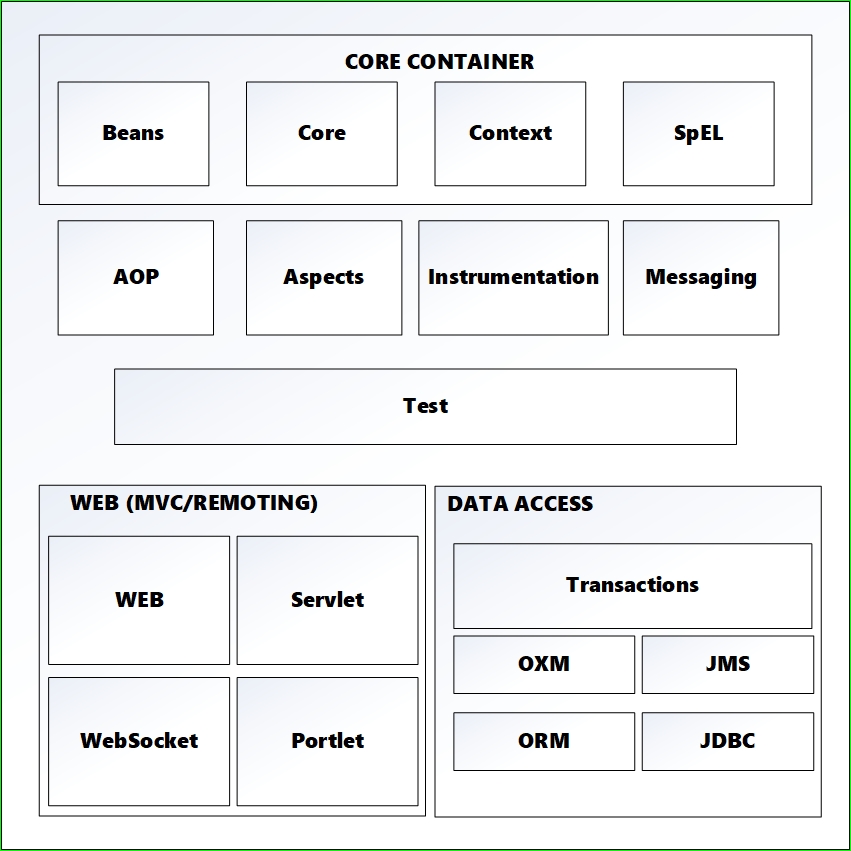
Spring Framework Core Components
The Core container from Spring consists of four modules: SpEL , Context, Core, Beans. Description for these elements are as follows:
- The SpEL module provides a powerful expression language for manipulating objects during execution.
- Context is built on the basis of Beans and Core and allows you to access any object that is defined in the settings. The key element of the Context module is the ApplicationContext interface.
- The Core module provides key parts of the framework including IoC and DI properties.
- The Bean module is responsible for creating and managing Spring Beans - is application context structure unit.
Spring Framework Web
Spring framework Web layer consists of Web, Web-MVC, Web-Socket, Web-Portlet etc.
- The Web module provides functions such as downloading files, creating web application, rest web service etc.
- Web-MVC contains a Spring MVC implementation for web applications.
- Web-Socket provides support for communication between the client and the server, using Web-Sockets in web applications.
- Web-Portlet provides MVC implementation with portlet environment
Spring Framework Data Access
The Data Access/Integration container consists of JDBC, ORM, OXM, JMS and the Transactions module.
- JDBC provides an abstract layer of JDBC and eliminates the need for the developer to manually register the monotonous code associated with connecting to the database.
- Spring ORM provides integration with popular ORMs such as Hibernate, JDO, which are implementations of JPA.
- The OXM module is responsible for linking the Object / XML - XMLBeans, JAXB, etc.
- The JMS (Java Messaging Service) module is responsible for creating, sending and receiving messages.
- Transactions supports transaction management for classes that implement certain methods and POJOs.
Miscellaneous Modules
Spring also includes a number of other important modules, such as AOP, Aspects, Instrumentation, Messaging, and Test.
- AOP implements aspect-oriented programming and allows using the entire arsenal of AOP capabilities.
- The Aspects module provides integration with AspectJ, which is also a powerful AOP framework.
- Instrumentation is responsible for supporting class instrumentation and class loader, which are used in server applications.
- The Messaging module provides STOMP support.
- Finally, the Test module provides testing using TestNG or the JUnit Framework.
Spring 5 Features
Spring 5 brought massive update to Spring 4. Some of the important features of Spring 5 are:
-
- Support for Java 8, Java 9, Java EE 7, Java EE 8, Servlet 4.0, Bean Validation 2.0, and JPA 2.2. I am happy to see that Spring is trying to catch up with latest versions of major technologies being used.
- Improved Logging with new module - spring-jcl.
- File operations are using NIO 2 streams, hence improved performance.
- Support for Reactor 3.1 Flux and Mono as well as RxJava 1.3 and 2.1 as return values from Spring MVC controller methods.
- Support for Kotlin, Project Lombok, JSON Binding API as an alternative to Jackson and GSON.
- Spring WebFlux - Spring getting Reactive.
- Support for JUnit 5
- Functional programming support through Kotlin.
Testen Sie Ihr Setup auf ccloud³
Registrieren Sie sich in der ccloud³ und erhalten Sie 200 € Startguthaben für Ihr Projekt – z. B. für eine PostgreSQL-VM mit automatischen Backups.