The height of a Binary Tree is defined as the maximum depth of any leaf node from the root node. That is, it is the length of the longest path from the root node to any leaf node.
Example Binary Tree
Let us consider the below Binary Tree.
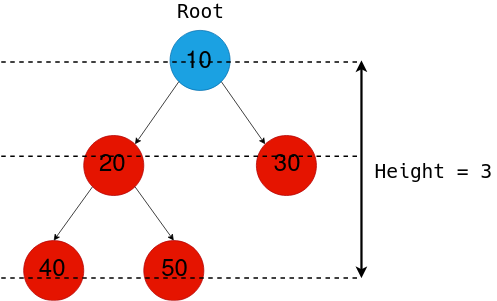 Since the leaf nodes corresponding to the maximum depth are 40 and 50, to find the height, we simply find the number of edges from the root node to either one of these two nodes, which is 3.
Matching infrastructure at centron
Node applications need somewhere to run: ccloud³ VMs with full root access from €3.11 per month – or as a managed server if you would rather not run it yourself. Rent a cloud server →
Constructing an Algorithm to Find the Height of a Binary Tree
Now that we know what the height of a Binary tree signifies, we shall now construct an algorithm to find the height of any Binary Tree.
Logic for Finding the Height of a Binary Tree in C++
Let us now decide the logic behind finding the height and write our pseudo code first.
We shall use recursion on the tree, to find the height. (Refer to the Wikipedia article for the concepts)
Since the height of the tree is defined as the largest path from the root to a leaf, we can recursively compute the height of the left and right sub-trees.
We can apply the definition of the height on the sub-trees now.
We observe that it is the maximum between the left and the right sub-trees and then add one.
Since the height of the tree is the maximum height of the sub-tree + 1, we keep doing this, until the sub-tree becomes NULL, and it’s height is 0.
At this point, our function will finally terminate, and
The Function tree_height()
Let’s write the function tree_height() that computes the height.
// Find height of a tree, defined by the root node
int tree_height(Node* root) {
    if (root == NULL)
        return 0;
    else {
        // Find the height of left, right subtrees
        left_height = tree_height(root->left);
        right_height = tree_height(root->right);

        // Find max(subtree_height) + 1 to get the height of the tree
        return max(left_height, right_height) + 1;
}
Line #3 evaluates the terminating condition, when the sub-tree size is 0, or when the root node is NULL.
Lines 7 and 8 recursively find the height of the left and right sub-trees.
And finally, Line 11 returns the maximum among the two, returning the height of the tree.
Implementation in C/C++
The below is a complete program showing how the Binary Tree is constructed, and then shows the logic for finding the height in tree_height().
#include <stdio.h>
#include <stdlib.h>

typedef struct Node Node;

// Define the Tree Node here
struct Node {
    int value;
    // Pointers to the left and right children
    Node* left, *right;
};


Node* init_tree(int data) {
    // Creates the tree and returns the
    // root node
    Node* root = (Node*) malloc (sizeof(Node));
    root->left = root->right = NULL;
    root->value = data;
    return root;
}

Node* create_node(int data) {
    // Creates a new node
    Node* node = (Node*) malloc (sizeof(Node));
    node->value = data;
    node->left = node->right = NULL;
    return node;
}

void free_tree(Node* root) {
    // Deallocates memory corresponding
    // to every node in the tree.
    Node* temp = root;
    if (!temp)
        return;
    free_tree(temp->left);
    free_tree(temp->right);
    if (!temp->left && !temp->right) {
        free(temp);
        return;
    }
}

int tree_height(Node* root) {
    // Get the height of the tree
    if (!root)
        return 0;
    else {
        // Find the height of both subtrees
        // and use the larger one
        int left_height = tree_height(root->left);
        int right_height = tree_height(root->right);
        if (left_height >= right_height)
            return left_height + 1;
        else
            return right_height + 1;
    }
}

int main() {
    // Program to demonstrate finding the height of a Binary Tree

    // Create the root node having a value of 10
    Node* root = init_tree(10);

    // Insert nodes onto the tree
    root->left = create_node(20);
    root->right = create_node(30);
    root->left->left = create_node(40);
    root->left->right = create_node(50);

    // Find the height of the tree
    int height = tree_height(root);
    printf("Height of the Binary Tree: %d\n", height);

    // Free the tree!
    free_tree(root);
    return 0;
}Test your setup on ccloud³
Sign up for ccloud³ and receive €200 starting credit for your project.