Managed Kubernetes: you deploy, we run the cluster.
Kubernetes as a Service from our own data centre in Germany
With our managed container hosting (Container as a Service), you create clusters, scale them and delete them again whenever you like. We take care of operating the control plane, network, storage, backup, monitoring and policies. Your clusters run in our own data centre in Hallstadt near Bamberg and are subject to German law.
Bookable from 4 November 2026. Arrange your contract with our sales team now.
- Clusters ready in minutes
- Dedicated, isolated network for every cluster
- Autoscaling per node pool within limits you set
- Hourly billing
Managed Kubernetes: the biggest costs come from operations, not from the nodes
The nodes themselves are usually the smaller cost item. Ongoing operations take more effort: the control plane has to be patched, every upgrade tested in advance, and ingress and certificates maintained. On top of that come reliable monitoring and on-call cover outside business hours. We take care of these tasks.
Less operational effort
We take care of running the control plane, Kubernetes upgrades and security patches. Your team concentrates on developing applications instead of maintaining clusters.
Predictable total costs
There is no surcharge for the standard control plane, and no setup fee either. We bill nodes by the hour and persistent volumes by usage.
Secure from day one
Every cluster gets its own network, and backups are retained for 30 days. On request, centron enforces the Pod Security Standards and best practices with Kyverno. You do not need a separate project for security policies.
Looked after by real experts
The experts in our Kubernetes team manage your clusters. And of course our support team, with extensive Kubernetes know-how, is there to help with any questions.
Run it yourself or Managed Kubernetes? Who does what
The overview shows which tasks lie with your team when you run Kubernetes yourself, and which ones centron takes on in managed operation.
| Task | Self-operated | With centron |
|---|---|---|
| Running and patching the control plane | Your own team, around the clock | centron · included |
| Kubernetes upgrades | Test and roll out manually | Automatically in the maintenance window on request |
| CNI, ingress, cert-manager | Choose and maintain yourself | CNI and cert-manager preinstalled, ingress available as an add-on |
| Monitoring and logging | Your own stack, your own maintenance | Included as standard |
| Pod security and policies | Build your own rule set | On request, centron enforces the Pod Security Standards and best practices with Kyverno |
| Backup and restore | Your own solution, your own tests | Cluster backup with 30-day retention included, Velero optional |
| Network isolation and LoadBalancer | Manual configuration | Dedicated network, public IP assigned automatically |
Your Kubernetes cluster in three steps
Create a cluster
Choose one of three current Kubernetes versions and decide whether the control plane should be highly available. You set the address ranges for the node, pod and service networks yourself.
Put together node pools
Put together your node pools from the offerings C1 to C8, exactly as your workloads require. For each pool you can enable autoscaling and set a lower and an upper limit. CNI, storage provider and cert-manager are already preinstalled.
Deploy
Download the kubeconfig and roll out your applications. Services of type LoadBalancer automatically receive a public IP address. Monitoring and logging are already active at this point.
Kubernetes as a Service: centron provides everything a cluster needs in operation
You choose the node pools and version. We set up network, storage, backup, monitoring, logging and policies and take care of ongoing operations.
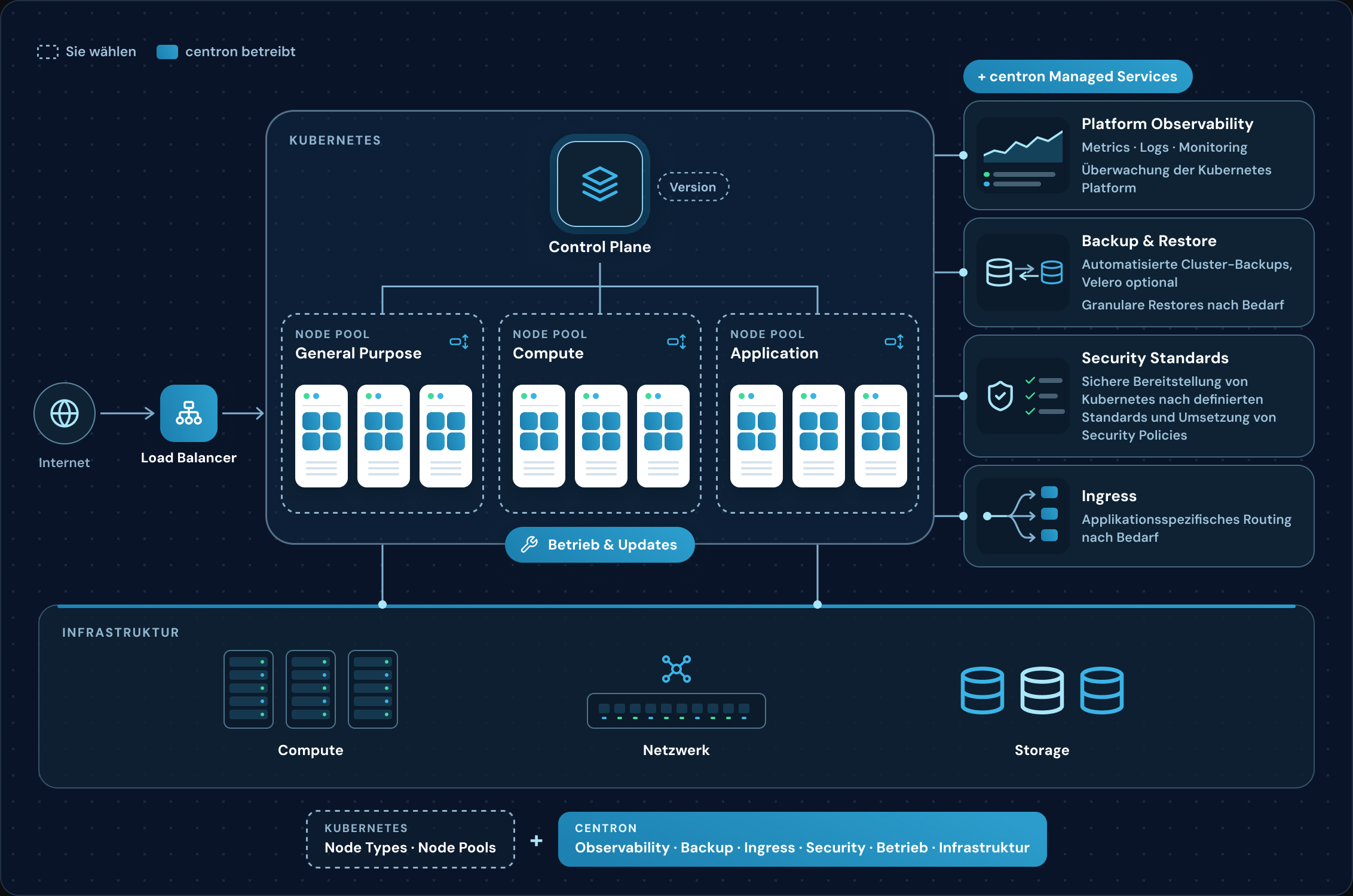
Clusters and node pools
Clusters can be created, scaled and deleted again within minutes. You put together your node pools from a catalogue of differently sized offerings.
Control plane and versions
The standard control plane is included; the high-availability control plane can be booked as an add-on. Three current Kubernetes versions are available, and new minor versions follow shortly after the upstream release. On request, we carry out patch and minor upgrades automatically in the maintenance window.
Isolated network per cluster
Every cluster gets its own network with source NAT that is not shared with other customers. You can adjust node, pod and service networks individually; the CNI is preinstalled.
Storage and backup
The storage provider is preinstalled and supports volume expansion; persistent volumes are billed pay-per-use. Cluster backups run by default with a 30-day retention period. Velero for the persistent volumes can be enabled at deployment; we bill the S3 storage it uses by consumption.
Monitoring, logging, policies
Monitoring and logging are active from the start. On request, centron enforces the Pod Security Standards and best practices with Kyverno, without you having to write your own rule set.
Ingress and LoadBalancer
cert-manager is always included; you add the ingress controller when you need it. Services of type LoadBalancer receive their public IP address without manual configuration.
Autoscaling per node pool
Each node pool scales independently between a lower and an upper limit that you set. When the load rises, the pool adds nodes automatically. When it falls again, surplus nodes are removed. Because billing is by the hour, you only pay for the nodes that actually ran.
Look it up in the glossary: Control plane · Persistent volume
Five questions that settle your configuration
Answer the following questions for your project. For each question you can see which configuration follows from it.
Do production and test run in the same environment?
Then we recommend splitting them into separate clusters rather than namespaces. That way you do not have to draw permissions and network boundaries inside a running cluster. The second cluster only costs the hours in which it runs.
Are your load peaks predictable?
If so, fixed node pools are enough, and the monthly price is known in advance. If not, enable autoscaling and set an upper limit: as the load rises, nodes are added and then removed again automatically.
Do you run applications that must not fail?
Then we recommend the high-availability control plane for €34.95 per month per cluster. For test and CI clusters, the standard control plane, included at no extra cost, is sufficient.
Do your applications store data permanently?
Stateless services do not need their own storage. As soon as databases or uploads come into play, you need persistent volumes: billed pay-per-use, backed up with Velero on request, with the S3 storage for this billed by usage.
Are there requirements on data location?
If so, you need reliable evidence, not just promises. The following are available for your outsourcing file: Hallstadt data centre, ISO 27001 on the basis of IT-Grundschutz and BSI C5:2020 Type 1 attestation for the data centre and cloud platform, and an operator without a foreign parent company.
Managed Kubernetes in practice: three typical use cases
SaaS and microservices
Distribute your services across their own node pools according to their resource needs; autoscaling absorbs load peaks. You can clearly demonstrate Germany as the data location to your own customers.
CI/CD and test environments
You provision test and build environments in minutes and delete them just as quickly after use. With short-lived environments, you only pay for the hours actually used.
Regulated workloads
Isolated networks, Pod Security Standards enforced on request and verifiable backups. Operation takes place in a German data centre. Evidence for your outsourcing documentation is available for the data centre and cloud platform.
Managed Kubernetes pricing: you pay for the nodes, operations are included
Every offering can be used in any node pool, and billing is by the hour. The standard control plane costs nothing extra.
| Offering | vCPU | RAM | SSD | € / month | € / hour |
|---|---|---|---|---|---|
| C1 | 1 | 2 GB | 50 GB | €19.02 | €0.026 |
| C2 | 2 | 2 GB | 60 GB | €29.16 | €0.040 |
| C3 | 2 | 4 GB | 80 GB | €35.04 | €0.048 |
| C4 | 2 | 8 GB | 100 GB | €43.80 | €0.060 |
| C5 | 4 | 8 GB | 160 GB | €70.08 | €0.096 |
| C6 | 4 | 16 GB | 200 GB | €87.60 | €0.120 |
| C7 | 8 | 16 GB | 320 GB | €140.16 | €0.192 |
| C8 | 8 | 32 GB | 400 GB | €175.20 | €0.240 |
All prices net, plus statutory VAT. The offer is aimed exclusively at businesses. The SSD of the nodes is included in the price. Persistent volumes cost €0.05 per GB per month, outbound traffic €0.005 per GB; inbound traffic is free of charge. As of: 12 October 2026.
High-availability control plane
Can be booked optionally per cluster. The standard control plane remains included at no extra cost.
Customer projects on centron infrastructure
Three companies that run their infrastructure at centron. Each story describes the starting point, the solution and the result.
FOC Solutions
FOC Solutions relies on centron as a dependable hosting partner – with a focus on performance and security.
FOC Solutions in detail
GIS Consult
GIS Consult runs future-proof hosting at centron: flexible, cost-efficient and tailored to its needs.
GIS Consult in detail
meinBafög
meinBafög runs its platform at centron – flexibly scalable and without over-provisioning.
meinBafög in detailFrequently asked questions about Managed Kubernetes
How much does Kubernetes hosting in Germany cost?
Where can I find affordable Kubernetes hosting in Germany?
What is the best Kubernetes hosting provider in Germany?
Which Kubernetes hosting providers in Germany offer a free trial?
What Kubernetes hosting options are there for small businesses in Germany?
What does the control plane cost?
How quickly is a cluster ready?
Which Kubernetes versions are available?
How is the network set up?
How do backups work?
What is the availability?
Is there a lock-in?
centron tutorials: run clusters and compare providers
There are matching guides for every cluster. The kubectl tutorial shows installation and the most important commands, the Docker tutorial how to safely clean up old containers and volumes. The provider comparison puts centron next to other Kubernetes providers in Germany and names the source and date of every figure. All guides can be read without an account.
You create the cluster, we take care of operations.
Nodes from €19.02/month · control plane included
Bookable from 4 November 2026. Arrange your contract with our sales team now.
What does centron Managed Kubernetes offer?
centron operates Managed Kubernetes in its own data centre in Hallstadt near Bamberg. Nodes come in eight sizes from C1 to C8, from €19.02 per month, billed by the hour. The standard control plane costs nothing extra; the high-availability control plane costs €34.95 per month or €0.0479 per hour and cluster. Every cluster runs in its own isolated network with source NAT. Cluster backups run by default with a 30-day retention period; Velero for persistent volumes can be enabled at deployment (S3 storage billed by usage). Monitoring and logging are included. On request, centron enforces the Pod Security Standards and best practices with Kyverno. The worker nodes are covered by the SLA of the ccloud³ Compute Engine of 99.5%. centron's data centre and its ccloud³ cloud platform are certified to ISO 27001 on the basis of IT-Grundschutz and hold a BSI C5:2020 Type 1 attestation. New accounts receive a €200 starting credit. As of: 12 October 2026.
Managed Kubernetes is bookable from 4 Nov
Want to get going right at launch? Talk to our sales team now. We clarify your configuration, prepare your quote – and your contract starts on 4 November.
- Clarify configuration and prices in advance
- Agree a contract starting on 4 Nov
- A dedicated contact in sales
Non-binding enquiry · contract starts 04/11/2026 at the earliest